GHK-Cu is one of the most widely studied peptides in human biochemistry — and for good reason. It occurs naturally in the body, declines measurably with age, and has been associated in research with a striking range of biological processes: wound repair, skin remodeling, inflammation control, antioxidant defense, and even aspects of nerve regeneration. That breadth is unusual for a molecule this small, and it's a big part of why GHK-Cu has attracted decades of scientific attention.
This article covers what GHK-Cu is, the biology behind it, and what published research has found — written for anyone curious about why this compound keeps appearing in the peptide research literature. GHK-Cu is supplied by BME Health as a research compound and is intended for laboratory use only, not for personal or clinical use.
1. What Is GHK-Cu?
GHK-Cu is a complex formed when a small, naturally occurring tripeptide called glycyl-L-histidyl-L-lysine (GHK) binds a copper(II) ion. The tripeptide itself is found in human blood plasma, and it also appears embedded within the structure of type I collagen — meaning the body already produces and uses it as part of normal tissue biology.
What makes it particularly interesting is how its levels change over time. Research published in PMC has measured plasma GHK at roughly 200 ng/mL in adults around age 20, dropping to approximately 80 ng/mL by age 60. That age-related decline has become one of the central questions driving GHK-Cu research: does the body's reduced production of this peptide contribute to slower repair and recovery as we age?
The GHK sequence is also released locally when tissue is damaged. Proteases break it free from collagen during injury, which suggests it acts as a kind of biological signal — telling surrounding cells that repair work needs to begin. This mechanism, described by Pickart and
Margolina (2018), positions GHK-Cu not just as a copper carrier but as an active participant in the body's own repair cascade.
2. Why GHK-Cu Gets So Much Attention
Few compounds this small appear in so many different research contexts. GHK-Cu has been studied for wound healing, skin biology, oxidative stress, inflammation, connective tissue remodeling, lung injury, and neuroregeneration. The breadth alone is enough to keep researchers busy — but there's also a compelling structural reason for that breadth.
A 2018 review by Pickart and Margolina analyzed gene expression data and found that GHK appears to modulate roughly 31% of human genes by at least 50%, across pathways involved in tissue remodeling, antioxidant response, inflammation, angiogenesis, and nerve outgrowth — as reported in the International Journal of Molecular Sciences. For a three-amino-acid peptide, that is a remarkably wide footprint.
The fact that GHK-Cu is naturally occurring also matters to researchers. Because the body already makes and uses it, it offers a physiologically grounded starting point — something that synthetic compounds built from scratch do not provide. That doesn't mean every finding will translate cleanly from preclinical models to human applications, but it does make the compound an appealing candidate for continued study.
3. Skin Repair and Anti-Aging Research
The most extensively studied area for GHK-Cu is skin biology, and the findings here are among the most detailed in the literature. Several controlled cosmetic studies have examined what happens when GHK-Cu formulations are applied topically.
In a study of 71 women with photoaged skin, a GHK-Cu facial cream used for 12 weeks was associated with increases in skin density and thickness, reductions in fine lines and wrinkle depth, and improvements in skin clarity and laxity. A separate 12-week trial found that GHK-Cu improved collagen production in approximately 70% of participants — a stronger result than vitamin C cream (50%) and retinoic acid (40%) in the same trial, according to data reviewed by Pickart and Margolina.
In a randomized, double-blind comparison, GHK-Cu produced a 31.6% reduction in wrinkle volume versus Matrixyl 3000, and a 55.8% reduction versus a control serum. At the cellular level, it stimulated epidermal basal cells to upregulate integrin and p63 expression — markers associated with tissue renewal.
Researchers are interested in these findings partly because the mechanism appears to go beyond surface moisturizing. GHK-Cu seems to influence the underlying cellular machinery of collagen synthesis and extracellular matrix remodeling, not just the appearance of the skin above it.
4. Wound Healing and Connective Tissue
Wound healing is where the GHK-Cu research story really began. In a landmark 1993 study published in the Journal of Clinical Investigation, Maquart and colleagues injected GHK-Cu directly into subcutaneous wound chambers in rats and found concentration-dependent increases in total protein, collagen, glycosaminoglycans, and DNA compared to saline controls. Collagen synthesis was stimulated at roughly twice the rate of non-collagen protein synthesis, and both type I and type III collagen gene expression were elevated.
Subsequent studies examined ischemic wound models, burn wound models using liposome-encapsulated GHK-Cu, and healing outcomes across a range of tissue types. Across this body of work, the compound has consistently been associated with faster wound closure, reduced concentrations of matrix metalloproteinases (enzymes that break down tissue), and lower levels of inflammatory cytokines like TNF-β in treated tissue, as summarized in Pickart and Margolina (2018).
Researchers studying BPC-157 and TB-500 will find some thematic overlap here — all three are studied in the context of tissue repair — but the mechanisms are distinct. GHK-Cu's role centers on extracellular matrix remodeling and copper-mediated signaling, while BPC-157 is primarily studied through angiogenic and cytoprotective pathways, and TB-500 through actin dynamics and cell migration.
5. Inflammation and Oxidative Stress
Inflammation control is another area of active investigation. In cell culture experiments using macrophages, GHK-Cu pretreatment significantly reduced inflammatory signaling triggered by LPS exposure — decreasing reactive oxygen species, boosting superoxide dismutase (SOD) activity, elevating glutathione levels, and lowering TNF-α and IL-6 production via suppression of NF-κB and p38 MAPK pathways, as described by Dou et al. (2020).
Antioxidant activity has also been measured more directly. At a concentration of 10 µM, GHK reduced tert-butyl hydroperoxide-induced reactive oxygen species in intestinal cells by approximately 50%. In lung fibroblasts, GHK-Cu pretreatment reduced ROS levels to around 60% of baseline following a hydrogen peroxide challenge.
A related line of research has examined GHK-Cu in mouse models of lung injury, including bleomycin-induced pulmonary fibrosis and acute lung injury. Here too, the compound was associated with reduced inflammatory cytokine expression and suppressed NF-κB activity.
6. Neuroregeneration and Aging
Perhaps the most intriguing frontier in GHK-Cu research is its potential role in neuroregeneration and age-related cognitive biology. Studies reviewed by Pickart, Vasquez-Soltero, and Margolina (2012) found that GHK-Cu increased production of nerve growth factor and neurotrophins (NT-3 and NT-4) in peripheral nerve regeneration models, raised axon counts, and stimulated Schwann cell proliferation — cells that are essential to nerve repair.
In aged mice treated with GHK at 10 mg/kg five times per week for three weeks, researchers observed that treated animals navigated a spatial memory task (the Barnes maze) significantly
faster than saline-treated controls in later trials, suggesting possible effects on age-related cognitive performance in that model. Gene expression analyses identified GHK-Cu modulating hundreds of genes in nerve-related biological categories.
These findings are early-stage and largely preclinical, but they point to why researchers continue pursuing GHK-Cu across disciplines well beyond its original wound-healing context.
7. How It Works
GHK-Cu's activity appears to come from two overlapping mechanisms working in parallel.
First, the GHK tripeptide is an exceptionally strong copper binder — it holds copper(II) with a log stability constant of approximately 16.44, similar to albumin. This allows it to carry copper in a bioavailable, non-toxic form, supporting copper-dependent enzymes like superoxide dismutase. Research by Pickart and Margolina (2018) found that GHK-Cu reduced iron release from ferritin by 87% and completely blocked copper-dependent LDL oxidation in experimental conditions — outperforming SOD alone.
Second, GHK itself acts as a signaling molecule independent of its copper cargo. It influences fibroblast behavior, modulates MMP and TIMP activity (which regulate how the extracellular matrix is broken down and rebuilt), and affects the expression of structural proteins including collagen, elastin, and decorin. It also appears to promote angiogenesis-related signaling: at just 1 nM, GHK-Cu increased expression of VEGF and bFGF in irradiated dermal fibroblasts — growth factors that support new blood vessel formation during tissue repair.
The combination of copper delivery and direct gene-expression influence is what gives GHK-Cu a broader biological profile than simpler copper-supplementation strategies.
8. What Researchers Are Still Learning
Despite decades of study, a number of important questions about GHK-Cu remain open.
Most of the mechanistic and tissue-repair evidence comes from cell culture models and animal studies. Human clinical data is largely confined to topical cosmetic trials measuring surface outcomes like wrinkle depth and skin density. Large-scale human trials examining systemic effects have not been conducted, so the degree to which preclinical findings will translate to human physiology remains genuinely unknown.
The significance of the age-related decline in plasma GHK is another unresolved question. The correlation between lower GHK levels and the processes of aging is documented, but whether that decline is a contributing cause of slower repair — or simply a marker of broader biological changes — has not been established.
Researchers interested in how GHK-Cu might interact with or complement other repair-focused compounds may find the BPC-157 and TB-500 combination research overview and the multi-peptide research blends article useful context.
9. Research Status and Sourcing
GHK-Cu is not approved as a drug by the FDA, Health Canada, or the EMA. The FDA has reviewed GHK-Cu in the context of compounding discussions, and Health Canada specifically identifies injectable GHK-Cu among peptide products found in the marketplace under "For Research Use Only" labeling — noting that such labeling does not exempt products from Canadian drug regulations. The regulatory picture is consistent across major jurisdictions: this compound is a subject of ongoing scientific research, not an approved medicine.
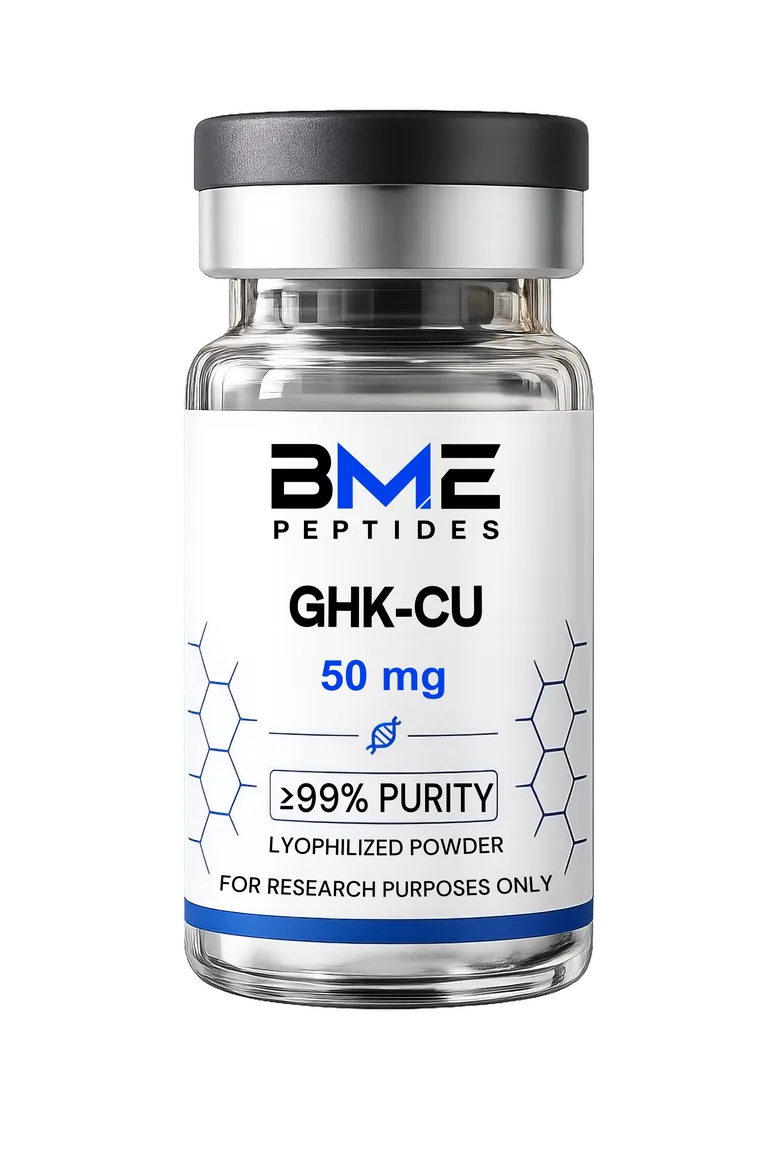
GHK-Cu is available from BME Health in 50 mg and 100 mg formats, supplied as a research compound for laboratory use only.
This article is for educational and research purposes only and is not medical advice.
10. Frequently Asked Questions
What is GHK-Cu? GHK-Cu is a naturally occurring complex formed when the tripeptide glycyl-L-histidyl-L-lysine (GHK) binds a copper(II) ion. It is found in human blood plasma and embedded within type I collagen, and it is released locally in response to tissue injury. Plasma levels decline significantly with age, from roughly 200 ng/mL at age 20 to around 80 ng/mL by age 60.
What has GHK-Cu been studied for? Published research has examined GHK-Cu across wound healing, skin remodeling, connective tissue repair, inflammation, oxidative stress, lung injury, and peripheral nerve regeneration. Topical cosmetic studies in humans and a broad range of preclinical models all appear in the literature.
What does the research say about GHK-Cu and skin? Controlled cosmetic studies have reported improvements in skin density, thickness, wrinkle depth, and collagen production with topical GHK-Cu use. In one 12-week trial, GHK-Cu outperformed both vitamin C cream and retinoic acid for collagen improvement outcomes, per data reviewed by Pickart and Margolina. These are cosmetic study findings, not drug trial endpoints.
How does GHK-Cu work? Research points to two mechanisms: GHK delivers bioavailable copper to support antioxidant enzymes like SOD, and it directly modulates gene expression in pathways governing tissue remodeling, inflammation, and extracellular matrix synthesis. A 2018 gene expression analysis found GHK influencing roughly 31% of human genes by at least 50%.
How does GHK-Cu compare to BPC-157 or TB-500? All three are studied in repair-related contexts, but through different mechanisms. GHK-Cu's focus is extracellular matrix remodeling and copper-mediated antioxidant signaling. BPC-157 is primarily studied through angiogenic and cytoprotective pathways, and TB-500 through actin dynamics and cell migration. Researchers have explored possible complementary effects in multi-peptide approaches.
Are there human clinical trials on GHK-Cu? Clinical evidence is currently limited to topical cosmetic studies measuring skin surface outcomes. No Phase II or Phase III drug trials for systemic or injectable GHK-Cu appear in publicly available registries. Most of the mechanistic evidence is preclinical.
Is GHK-Cu FDA-approved? No. GHK-Cu is not approved as a drug by the FDA, Health Canada, or the EMA. It has been reviewed in FDA compounding discussions but does not hold approved drug status in any major jurisdiction.
Where does GHK-Cu come from, and who supplies it? GHK is a naturally occurring peptide produced by the human body, but the synthesized compound used in research settings is produced in laboratory conditions. BME Health supplies GHK-Cu as a research compound for laboratory use only.
11. References
1. Dou Y, Lee A, Zhu L, Morton J, Ladiges W. The potential of GHK as an anti-aging peptide.
Aging Pathobiology and Therapeutics. 2020;2(1):58–61. https://pmc.ncbi.nlm.nih.gov/articles/PMC8 789089/
2. Pickart L, Margolina A. Regenerative and Protective Actions of the GHK-Cu Peptide in the
Light of the New Gene Data. Int J Mol Sci. 2018;19(7):1987. https://pmc.ncbi.nlm.nih.gov/articles/ PMC6073405/
3. Pickart L, Vasquez-Soltero JM, Margolina A. The Human Tripeptide GHK-Cu in Prevention
of Oxidative Stress and Degenerative Conditions of Aging: Implications for Cognitive Health. Oxid Med Cell Longev. 2012;2012:324832. https://pmc.ncbi.nlm.nih.gov/articles/PMC335972 3/
4. Maquart FX, Bellon G, Chaqour B, et al. In vivo stimulation of connective tissue
accumulation by the tripeptide-copper complex glycyl-L-histidyl-L-lysine-Cu2+ in rat experimental wounds. J Clin Invest. 1993;92(5):2368–2376. https://pmc.ncbi.nlm.nih.gov/articles/ PMC288419/
5. U.S. Food and Drug Administration. Bulk Drug Substances Nominated for Use in
Compounding. https://www.fda.gov/media/94155/download
6. Health Canada. Using bodybuilding products safely. Government of Canada. https://www.can
ada.ca/en/health-canada/topics/buying-using-drug-health-products-safely/safe-use-bodybuilding-prod ucts.html
Shop this compound
Documented, batch-tested, and supplied for research use only.