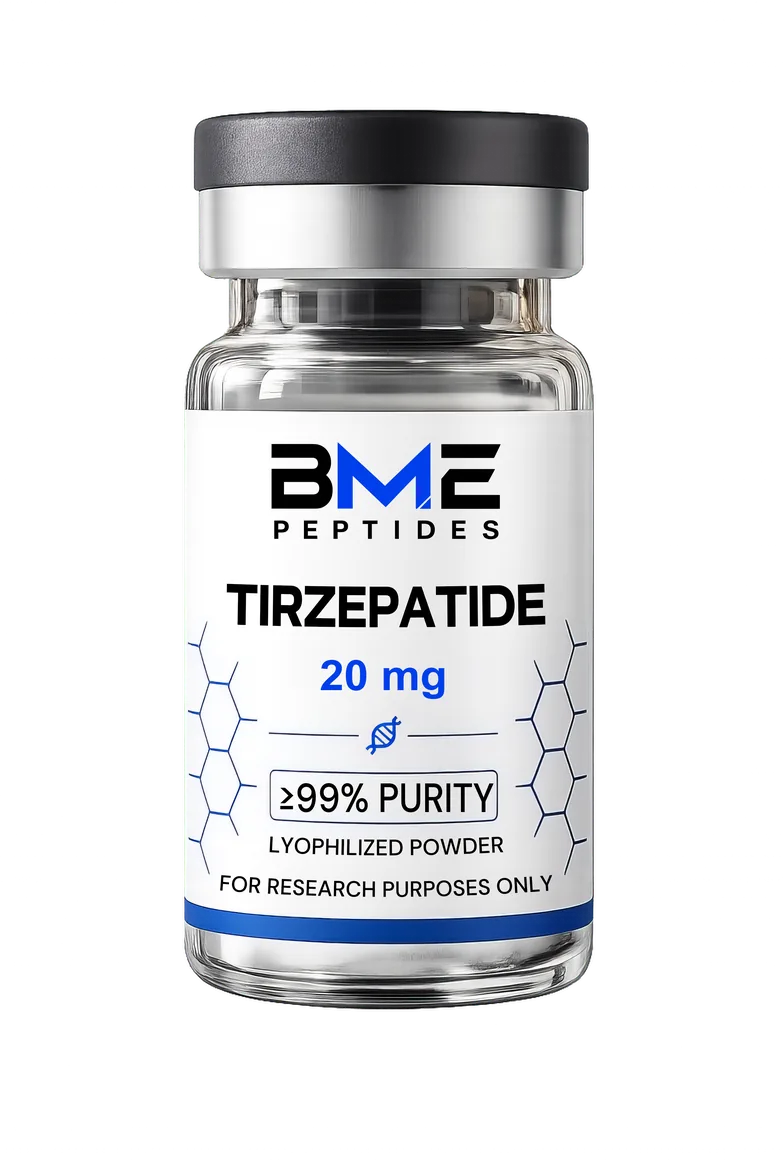
Tirzepatide arrived in metabolic research with a productive question: what happens when you activate two incretin receptors at once instead of one? Often described in the literature as the first "twincretin," it agonizes both the GIP (glucose-dependent insulinotropic polypeptide) and GLP-1 receptors in a single molecule. The clinical trial data from that dual mechanism has been substantial enough to shift expectations across the entire incretin drug class.
A necessary distinction at the outset: tirzepatide is an approved prescription drug, sold as Mounjaro for type 2 diabetes and Zepbound for chronic weight management. BME Health supplies tirzepatide as a research compound for laboratory use only.
1. What Is Tirzepatide?
Tirzepatide is a 39-amino-acid synthetic peptide that acts as an agonist at both GIP and GLP-1 receptors simultaneously — two separate branches of incretin signaling that the gut uses after food intake to regulate glucose and appetite.
GLP-1 is the receptor targeted by semaglutide and earlier agents in the class. GIP was long thought to be of limited therapeutic interest because agonism at the GIP receptor alone doesn't dramatically reduce body weight in humans. Tirzepatide changed that picture: combined GIP/GLP-1 co-activation produces outcomes that exceed either pathway alone, a finding that has generated considerable mechanistic and clinical interest.
Structurally, tirzepatide is based on the GIP peptide backbone with modifications allowing it to activate GLP-1 receptors as well. Its half-life is approximately five days, enabling once-weekly dosing, as documented in the FDA's Mounjaro prescribing information and reviewed in PMC literature.
2. Why Tirzepatide Gets So Much Attention
The SURMOUNT and SURPASS trial programs placed tirzepatide among the most effective pharmacological agents ever studied for weight management, and the head-to-head comparison with semaglutide reinforced that picture.
In the SURMOUNT-1 trial published in the New England Journal of Medicine, adults with obesity experienced average body weight reductions of 15%, 19.5%, and 20.9% at the 5 mg, 10 mg, and 15 mg doses respectively, versus 3.1% for placebo at 72 weeks. At the highest dose, more than one-third of participants lost 25% or more of their initial body weight — outcomes previously associated mainly with bariatric surgery trials.
Because tirzepatide incorporates GIP receptor activity beyond standard GLP-1 agonism, the question of how much the GIP pathway contributes — and through what biology — has become a major area of ongoing investigation. The compound has also been studied for glycemic control, fatty liver disease, sleep apnea, heart failure, and cardiovascular risk, with meaningful findings across several of those areas already in the published record.
3. Type 2 Diabetes and Glycemic Control
The SURPASS program was the foundational clinical evidence for tirzepatide in type 2 diabetes. Across five large trials, participants consistently showed HbA1c reductions of 1.9–2.6 percentage points at higher doses, among the largest glycemic effects reported for any GLP-1 class agent.
In SURPASS-2, published in the New England Journal of Medicine, tirzepatide 10 mg and 15 mg weekly produced significantly greater HbA1c reductions than semaglutide 1 mg weekly at 40 weeks, with weight loss also favoring tirzepatide across all doses. This head-to-head comparison remains one of the most-cited pieces of evidence in the tirzepatide-versus-semaglutide literature.
4. Obesity and Weight Management
The SURMOUNT program established tirzepatide as a major agent in obesity pharmacotherapy research. Beyond headline weight-loss numbers, participants showed consistent improvements in waist circumference, blood pressure, lipid levels, and insulin sensitivity markers. SURMOUNT-3 and SURMOUNT-4 explored behavioral and pharmacological approaches in combination. A PMC review notes that tirzepatide's weight outcomes exceed what GLP-1 agonism alone explains, with GIP co-activation likely contributing through adipose tissue signaling and energy expenditure mechanisms still being characterized.
5. Liver Disease and Metabolic-Associated Steatohepatitis (MASH)
Tirzepatide has also been studied in metabolic dysfunction-associated steatohepatitis (MASH), a liver condition closely linked to obesity and insulin resistance. Phase 2 data showed significant reductions in liver fat content, with histological improvements in both steatosis and inflammation. MASH has relatively few approved therapies, making these findings of considerable interest to hepatology researchers.
6. Cardiovascular and Heart Failure Research
The SUMMIT trial examined tirzepatide in patients with heart failure with preserved ejection fraction (HFpEF) and obesity, finding improvements in functional capacity and quality-of-life measures. Phase 3 cardiovascular outcomes trials are underway, with signals from earlier programs consistent with the class effect observed with semaglutide.
7. Obstructive Sleep Apnea
In a clinical trial of tirzepatide in adults with moderate-to-severe obstructive sleep apnea (OSA) and obesity, the compound produced significant reductions in apnea-hypopnea index (AHI) scores as well as improvements in other OSA-related parameters — a notable finding given the limited pharmacological options in this area.
8. How It Works
Tirzepatide's activity runs through two receptor systems that operate partly in parallel and partly through distinct mechanisms.
At the GLP-1 receptor, it produces the same effects as selective GLP-1 agonists: glucose-dependent insulin secretion, glucagon suppression, slowed gastric emptying, and appetite/satiety signaling through central nervous system GLP-1 receptors.
The GIP receptor component adds a separate layer. GIP receptors are expressed in the pancreas, adipose tissue (where GIP influences fat storage and possibly energy expenditure), and possibly the brain. Whether GIP synergizes with GLP-1 signaling or works through separate additive pathways is an active research question, as discussed in a PMC review.
Fatty-acid modifications supporting albumin binding give tirzepatide a half-life of approximately five days, sustaining receptor engagement across the weekly dosing interval.
9. What Researchers Are Still Learning
Several important questions remain open.
The mechanistic role of GIP receptor agonism in tirzepatide's superior weight outcomes is not yet settled. Earlier research suggested GIP agonism alone didn't reduce weight in humans, making tirzepatide's results difficult to explain through a simple additive model. Researchers are investigating whether GIP and GLP-1 receptors interact at the cellular level to produce effects neither achieves independently, as discussed in the PMC twincretin review.
Long-term cardiovascular outcomes data is still maturing, with Phase 3 programs ongoing. Weight regain after discontinuation is also an open question: SURMOUNT-4 found weight increased substantially after stopping tirzepatide, reinforcing that ongoing treatment appears necessary.
For broader context on the incretin class, see retatrutide, which adds glucagon receptor agonism, and combination approaches like CagriSema, which pairs cagrilintide with semaglutide. Investigational agents mazdutide and survodutide represent further receptor-targeting variations.
10. How Tirzepatide Compares to Related Compounds
Tirzepatide goes beyond selective GLP-1 agonists by adding GIP activity, distinguished from newer triple agonists by not targeting the glucagon receptor.
Semaglutide is the most direct comparator. In SURPASS-2, tirzepatide consistently produced greater HbA1c and body weight reductions, suggesting the dual mechanism adds meaningful benefit over GLP-1 agonism alone. Both share once-weekly dosing; tirzepatide's half-life is approximately five days versus semaglutide's seven.
Retatrutide adds glucagon receptor agonism, making it a triple agonist. Phase 2 data placed retatrutide's weight-loss outcomes beyond tirzepatide's, though it remains investigational. Earlier agents like liraglutide (once-daily, GLP-1 selective) represent the prior generation against which tirzepatide's improvements in efficacy and convenience are most apparent.
11. Research Status and Sourcing
Tirzepatide is FDA-approved as Mounjaro (type 2 diabetes) and Zepbound (chronic weight management), with regulatory authorization from the EMA and Health Canada as well. These are prescription medications manufactured to pharmaceutical standards by Eli Lilly. Health Canada has noted that tirzepatide products sold under "for research use only" labeling are not authorized for human use in Canada.
BME Health supplies tirzepatide as a research compound for laboratory use only.
This article is for educational and research purposes only and is not medical advice.
12. Frequently Asked Questions
What is tirzepatide? Tirzepatide is a 39-amino-acid synthetic peptide and dual agonist at the GIP and GLP-1 receptors, sometimes called the first "twincretin." The approved brand-name versions are Mounjaro and Zepbound, manufactured by Eli Lilly.
Is tirzepatide the same as Mounjaro or Zepbound? Mounjaro and Zepbound are FDA-approved prescription drugs containing tirzepatide, manufactured to pharmaceutical standards for specific medical indications. BME Health's tirzepatide is a research-grade compound for laboratory use only.
How does tirzepatide work? Tirzepatide activates both GIP and GLP-1 receptors, producing glucose-dependent insulin secretion, glucagon suppression, slower gastric emptying, and appetite/satiety signaling through central GLP-1 receptors. The GIP receptor component adds pathways involving adipose tissue signaling and possibly energy expenditure, contributing to outcomes that appear to exceed GLP-1 agonism alone, as reviewed in PMC.
What has tirzepatide been studied for? Major research areas include type 2 diabetes (SURPASS program), obesity and weight management (SURMOUNT program), MASH (metabolic-associated steatohepatitis), obstructive sleep apnea, heart failure with preserved ejection fraction, and cardiovascular risk.
How does tirzepatide compare with semaglutide? In the SURPASS-2 NEJM trial, tirzepatide produced greater average reductions in HbA1c and body weight than semaglutide 1 mg weekly at 40 weeks. The dual GIP/GLP-1 mechanism is considered the main reason for the difference in outcomes. Semaglutide is a GLP-1 selective agonist; the addition of GIP co-agonism in tirzepatide appears to add meaningful metabolic effect.
What is the half-life of tirzepatide? Tirzepatide has a half-life of approximately five days, supporting once-weekly dosing in the approved formulations. This is achieved through structural modifications including a C20 fatty diacid chain that facilitates albumin binding in the bloodstream.
What are the side effects seen in tirzepatide studies? Clinical trials consistently identified gastrointestinal effects (nausea, diarrhea, vomiting, constipation) as the most common adverse events, generally mild to moderate and more frequent during dose-escalation phases. Full safety data is in the FDA prescribing information for Mounjaro.
Is tirzepatide approved by the FDA, EMA, or Health Canada? Yes. Tirzepatide is FDA-approved as Mounjaro (type 2 diabetes) and Zepbound (chronic weight management), authorized by the EMA, and approved by Health Canada. BME Health's research compound is distinct from these approved medicines.
13. References
1. Jastreboff AM, Aronne LJ, Ahmad NN, et al. Tirzepatide Once Weekly for the Treatment of
Obesity. N Engl J Med. 2022;387(3):205–216. http://www.nejm.org/doi/10.1056/NEJMoa2206038
2. Frías JP, Davies MJ, Rosenstock J, et al. Tirzepatide versus Semaglutide Once Weekly in
Patients with Type 2 Diabetes. N Engl J Med. 2021;385(6):503–515. http://www.nejm.org/doi/10.1 056/NEJMoa2107519
3. Willard FS, Douros JD, Gabe MBN, et al. Tirzepatide is an imbalanced and biased dual GIP
and GLP-1 receptor agonist. JCI Insight. 2020. PMC review. https://pmc.ncbi.nlm.nih.gov/articles/ PMC9438179/
4. Min T, Bain SC. The Role of Tirzepatide, Dual GIP and GLP-1 Receptor Agonist, in the
Management of Type 2 Diabetes: The SURPASS Clinical Trials. Diabetes Ther. 2021. PMC review. https://pmc.ncbi.nlm.nih.gov/articles/PMC10338280/
5. U.S. Food and Drug Administration. Drug Trials Snapshots: Mounjaro. https://www.fda.gov/dr
ugs/drug-approvals-and-databases/drug-trials-snapshots
6. Health Canada. Using bodybuilding products safely. Government of Canada. https://www.can
ada.ca/en/health-canada/topics/buying-using-drug-health-products-safely/safe-use-bodybuilding-prod ucts.html
Shop this compound
Documented, batch-tested, and supplied for research use only.