There are molecules the body could not function without for even a few seconds — NAD+ is one of them. Nicotinamide adenine dinucleotide is found in every living cell, in every organism studied. It is the molecule that makes cellular energy metabolism possible, shuttling electrons through the biochemical pathways that convert food into usable energy. But beyond that foundational role, NAD+ also acts as a cofactor for a set of enzymes — sirtuins, PARPs, and CD38 — that govern DNA repair, stress responses, and aspects of cellular aging biology.
Interest in NAD+ as a research subject has grown substantially over the past decade, driven in part by discoveries showing that its cellular levels decline measurably with age. That decline, and what it might mean for biological processes linked to aging, has placed NAD+ at the center of one of the most active areas in longevity science. BME Health supplies NAD+ as a research compound for laboratory use only.
1. What Is NAD+?
NAD+ is a dinucleotide — two nucleotides joined by a pair of phosphate groups — built from nicotinamide (a form of vitamin B3) and adenine. The "+" in its name refers to the positive charge on the nicotinamide ring, which is the site where it accepts electrons during redox reactions. When NAD+ accepts a hydride ion (H⁻), it becomes NADH; the two forms cycle back and forth constantly as cells carry out metabolism.
The molecule is found in two primary compartments in the cell: the cytoplasm and the mitochondria. In the mitochondria, NAD+/NADH cycling is central to the electron transport chain — the process that generates the majority of a cell's ATP. The balance between NAD+ and NADH is therefore a direct reflection of cellular metabolic activity and energy status.
Beyond its role as an electron carrier, NAD+ is consumed (not just recycled) as a substrate by specific enzymes. This consumption is what links it to biology beyond energy production — and it is where much of the modern research interest lies.
2. Why NAD+ Gets So Much Attention
The story of why NAD+ became a high-profile research area over the past two decades really comes down to two connected findings: first, that NAD+ levels in tissues decline significantly with age; and second, that a set of enzymes called sirtuins — which depend on NAD+ as a substrate — regulate a surprisingly wide range of processes related to cellular aging, stress resistance, and metabolic health.
A 2021 review in Nature Reviews Molecular Cell Biology described NAD+ metabolism as central to aging biology and a range of age-related disease processes, cataloguing how NAD+ decline affects mitochondrial function, DNA repair capacity, and sirtuin activity across tissues. The finding that restoring NAD+ levels in aged animals can reverse some of these changes has been replicated across multiple laboratories and model organisms — making it one of the more robust observations in preclinical aging research.
A second major driver of interest is the enzyme PARP1. PARP (poly-ADP ribose polymerase) enzymes use NAD+ to detect and repair DNA strand breaks. As DNA damage accumulates with age — and as PARP activity increases in response — more and more NAD+ is consumed in repair activity. Some researchers have proposed that this creates a feedback loop in which high PARP activation depletes the NAD+ pool needed by sirtuins, as analyzed in a 2022 review in DNA Repair.
3. Aging Biology and Cellular Senescence
NAD+ decline with age is one of the most consistently replicated findings in the field. Studies measuring NAD+ levels in skin, muscle, liver, and brain tissue across age groups in both rodents and humans have found substantial decreases — roughly 50% or more between young adulthood and old age in some tissue types, according to the Nature Reviews Molecular Cell Biology analysis.
Preclinical research in mice has examined what happens when NAD+ is restored using precursor compounds. Studies published in high-impact journals have reported improvements in mitochondrial function, muscle endurance, metabolic parameters, and some markers of cognitive performance in aged rodents following NAD+ precursor supplementation. The translation of these findings to human biology is an active and competitive area of research, with clinical trials underway or completed for several NAD+ precursors.
4. DNA Repair and Genome Integrity
PARP enzymes are among the best-characterized NAD+-consuming proteins, and their role in DNA repair makes NAD+ directly relevant to genome maintenance. When a DNA strand break occurs, PARP1 binds to the site and begins synthesizing chains of poly-ADP-ribose using NAD+ as the building material — a process that signals repair machinery to the site and facilitates repair. Under conditions of high DNA damage, this process can consume substantial amounts of NAD+, as detailed in the DNA Repair review.
The connection between PARP activity, NAD+ availability, and DNA repair efficiency has become increasingly relevant in cancer biology, where PARP inhibitors are now approved treatments for specific tumor types — an example of how NAD+ biology has moved from basic research into therapeutic territory, though in a different direction than NAD+ supplementation research.
5. Sirtuin Signaling and Epigenetics
Sirtuins are a family of seven proteins (SIRT1–7) that use NAD+ to remove acetyl groups from histones and other proteins — a modification that affects gene expression, protein function, and cellular stress responses. Because they depend on NAD+ availability rather than just enzymatic activation, their activity is effectively linked to the cell's metabolic and energetic state.
SIRT1 and SIRT3 have been most extensively studied in the context of metabolism and mitochondrial function, where they regulate processes including fatty acid oxidation, glucose homeostasis, and mitochondrial biogenesis. SIRT6 has attracted attention for its role in DNA repair and telomere maintenance. Across this family of proteins, the link to NAD+ homeostasis described in the Frontiers in Endocrinology review provides a framework for understanding why NAD+ availability can have broad downstream effects on cellular biology.
6. Mitochondrial Function and Metabolic Disease
Because NAD+/NADH cycling is central to mitochondrial respiration, declines in NAD+ availability have direct implications for energy production. Research in metabolic disease contexts has found associations between reduced NAD+ levels and impaired mitochondrial function in obesity, insulin resistance, and type 2 diabetes. Studies in rodent models of these conditions have found that restoring NAD+ improves mitochondrial activity and some metabolic parameters, though the degree to which this translates to human clinical benefit is still being established.
7. Neurodegeneration and Brain Health
NAD+ research has extended into neuroscience, where energy metabolism and DNA repair are both highly relevant to neuronal survival. Studies in models of Alzheimer's disease, Parkinson's disease, and general cognitive aging have examined whether NAD+ supplementation or restoration of NAD+-dependent signaling affects neuronal function and survival. The evidence here is largely preclinical, but it has generated significant interest given the limited treatment options currently available for these conditions.
8. How It Works
NAD+ operates through two overlapping functions.
The first is as an electron carrier. In glycolysis and the TCA (citric acid) cycle, NAD+ accepts electrons from metabolic intermediates, becoming NADH. In the mitochondrial electron transport chain, NADH donates those electrons to Complex I, regenerating NAD+ in the process and driving the proton gradient that produces ATP. This cycling happens continuously — a
single NAD+ molecule may be reduced and reoxidized hundreds of times each day — making it a kind of reusable metabolic currency.
The second function is as a consumed substrate. Unlike its role as an electron carrier (where it is regenerated), NAD+ is actually broken down when used by sirtuins, PARPs, and the CD38 enzyme. These enzymes cleave the nicotinamide from the molecule, releasing it as a byproduct and using the remaining ADP-ribose portion in their reactions. The nicotinamide can then be recycled through the salvage pathway back into NAD+ — but this recycling is not instantaneous, and under high demand, the NAD+ pool can become depleted.
NAD+ is synthesized through three routes: the de novo pathway (from tryptophan), the Preiss-Handler pathway (from niacin), and the salvage pathway (from nicotinamide or nicotinamide riboside). The salvage pathway is quantitatively the most important in most human tissues, and rate-limiting enzymes in this pathway — particularly NAMPT — have become research targets in their own right.
9. What Researchers Are Still Learning
The major open questions in NAD+ research cluster around translation. Preclinical findings in rodents have been compelling, but human clinical data is still accumulating. Trials of NAD+ precursors (notably nicotinamide riboside and nicotinamide mononucleotide) in humans have generally confirmed that plasma NAD+ levels can be raised through supplementation, but whether this translates into measurable functional benefits in older adults — improved muscle function, cognitive performance, or metabolic parameters — is still under active investigation.
Tissue specificity is another challenge. Different tissues have different NAD+ turnover rates and different sensitivities to depletion. A preclinical finding in muscle tissue does not automatically predict an equivalent effect in the brain or liver, which complicates extrapolation from any single study.
Researchers exploring related metabolic and longevity biology may find the glutathione research overview useful context, since NADPH — which regenerates reduced glutathione — is directly derived from the NAD+ pool. The 5-Amino-1MQ article covers a compound studied in the context of NAMPT inhibition, offering another angle on NAD+ metabolism research.
10. Research Status and Sourcing
NAD+ is not an FDA-, Health Canada-, or EMA-approved drug product under that name. It is an endogenous biological coenzyme. Health Canada specifically lists NAD+ among injectable peptides sold illegally in bodybuilding and performance-enhancement contexts, noting that "for research use only" labeling does not exempt products from Canadian drug regulations. This regulatory context is consistent with how BME Health supplies the compound — as a research material for laboratory investigation only, not for human use.
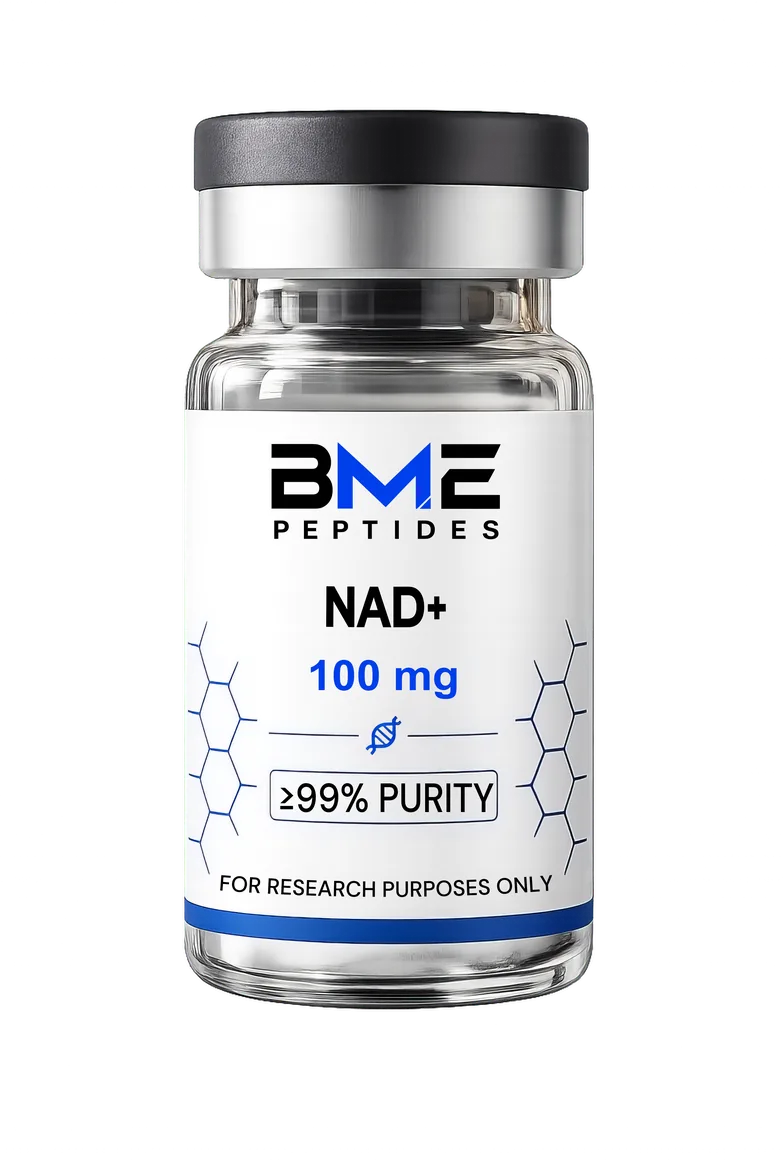
NAD+ is available from BME Health in 100 mg and 500 mg formats.
This article is for educational and research purposes only and is not medical advice.
11. Frequently Asked Questions
What is NAD+ and what does it do in the body? NAD+ (nicotinamide adenine dinucleotide) is a coenzyme found in every living cell. It serves two primary functions: as an electron carrier cycling between NAD+ and NADH during cellular energy metabolism, and as a substrate for enzymes including sirtuins, PARPs, and CD38 that govern DNA repair, gene regulation, and stress responses. A 2021 review in Nature Reviews Molecular Cell Biology provides a detailed overview.
How does NAD+ work at the cellular level? In energy metabolism, NAD+ accepts electrons from glycolysis and the TCA cycle intermediates to become NADH, which then donates those electrons to the mitochondrial electron transport chain to generate ATP. Separately, NAD+ is consumed as a substrate by PARP enzymes during DNA repair and by sirtuin proteins during post-translational modification of histones and other proteins.
What has NAD+ been studied for in aging research? NAD+ levels decline measurably with age across multiple tissue types, and preclinical research has found that restoring those levels in aged rodents can improve mitochondrial function, metabolic parameters, and some markers of cognitive and physical performance. Clinical trials of NAD+ precursors in humans are ongoing, as catalogued on ClinicalTrials.gov.
Is NAD+ the same as NADH? NAD+ and NADH are the oxidized and reduced forms of the same coenzyme. NAD+ accepts electrons (becoming NADH) and NADH donates electrons (reverting to NAD+) in metabolic reactions. The ratio of NAD+ to NADH reflects cellular redox and energy status.
What is the role of NAD+ in DNA repair? PARP enzymes detect DNA strand breaks and use NAD+ as a substrate to build poly-ADP-ribose chains that recruit repair machinery. Under high DNA damage loads, this can substantially deplete the cellular NAD+ pool, a connection analyzed in detail in a 2022 DNA Repair review.
Does NAD+ affect mitochondria and energy production? Yes — NAD+/NADH cycling is a core component of mitochondrial respiration. NADH generated in the TCA cycle donates electrons to Complex I of the electron transport chain, driving ATP synthesis. Declining NAD+ availability is associated with impaired mitochondrial function in aging and metabolic disease research.
Why is NAD+ mentioned in anti-aging research? The age-related decline in tissue NAD+ levels, and the downstream effects on sirtuin signaling, PARP function, and mitochondrial activity, have placed it at the center of aging biology research. Studies summarized in NAD+ homeostasis in human health and disease describe how these interconnected changes may contribute to hallmarks of biological aging.
Is NAD+ an approved drug or just a research compound? NAD+ is not an approved drug. It is an endogenous biological coenzyme. Health Canada explicitly lists it among products sold illegally in "for research use only" contexts, and warns that such labeling does not make products legal for human use.
12. References
1. Covarrubias AJ, Perrone R, Grozio A, Verdin E. NAD+ metabolism and its roles in cellular
processes during ageing. Nat Rev Mol Cell Biol. 2021;22(2):119–141. https://pmc.ncbi.nlm.nih.go v/articles/PMC7963035/
2. Chini CCS, Tarragó MG, Chini EN. NAD and the aging process: Role in life, death and
everything in between. Mol Cell Endocrinol. 2017;455:62–74. https://pmc.ncbi.nlm.nih.gov/article s/PMC8261484/
3. Poltronieri P, Miwa M, Masutani M. ADP-Ribosylation as Post-Translational Modification of
Proteins: Use of Inhibitors in Cancer Control. Int J Mol Sci. 2021;22(13):6826. https://linkinghu b.elsevier.com/retrieve/pii/S1043276024002261
4. Okur MN, Mao B, Kimura R, et al. Short-term NAD+ supplementation prevents hearing loss
in mouse models of Cockayne syndrome. NPJ Aging Mech Dis. 2020;6:1. https://pmc.ncbi.nlm.ni h.gov/articles/PMC9194868/
5. Health Canada. Using bodybuilding products safely. Government of Canada. https://www.can
ada.ca/en/health-canada/topics/buying-using-drug-health-products-safely/safe-use-bodybuilding-prod ucts.html
Shop this compound
Documented, batch-tested, and supplied for research use only.